Why Do Piles Come Back After Treatment? — A Rohini Proctologist Explains

If you have been treated for piles — whether with IRC, laser, stapler surgery, or open surgery — and your symptoms have returned, you are not alone and you have not failed. Recurring piles are often not a sign that treatment has failed, but a reminder that the underlying causes still need attention.
This is the most important thing to understand about piles recurrence: the procedure removes or destroys the existing haemorrhoidal tissue. It does not remove the conditions — constipation, straining, low fibre, prolonged sitting — that caused the haemorrhoids to form in the first place. If those conditions continue unchanged after treatment, new haemorrhoids form in the same location over months or years.
After 37 years of treating piles at Goyal Piles Care Centre in Rohini, Dr. Sushil Goyal has seen this pattern thousands of times. This article explains exactly why piles come back, how to distinguish a genuine recurrence from a new presentation, and what permanently prevents it from happening again.
What Does "Piles Coming Back" Actually Mean?
Before discussing why recurrence happens, it is worth being precise about what is actually recurring — because the answer matters for treatment.
True recurrence: The same haemorrhoidal columns that were previously treated have reformed. This is less common after laser haemorrhoidoplasty and stapler surgery, which address the haemorrhoidal tissue more completely. It is more common after IRC, where multiple sessions treat different columns progressively.
New haemorrhoid development: New haemorrhoids forming in previously unaffected tissue — because the underlying causes (constipation, straining, poor diet) were not corrected after treatment. This is far more common than true recurrence and is often misidentified as "the treatment failed" when it is actually "the cause was not addressed."
Incomplete treatment: Some haemorrhoidal columns were not fully treated in the original procedure. Symptoms appeared to resolve, then returned as the remaining tissue progressed. This is why accurate grading before treatment and experienced surgical technique during it are critical.
Understanding which of these three situations is causing your symptoms changes the management approach entirely. Some recurrent symptoms can be managed with conservative treatment or an office procedure, while others require a different surgical approach. The key is to choose treatment based on the current condition rather than assuming the same procedure used previously is automatically required again.
The 5 Real Reasons Piles Come Back
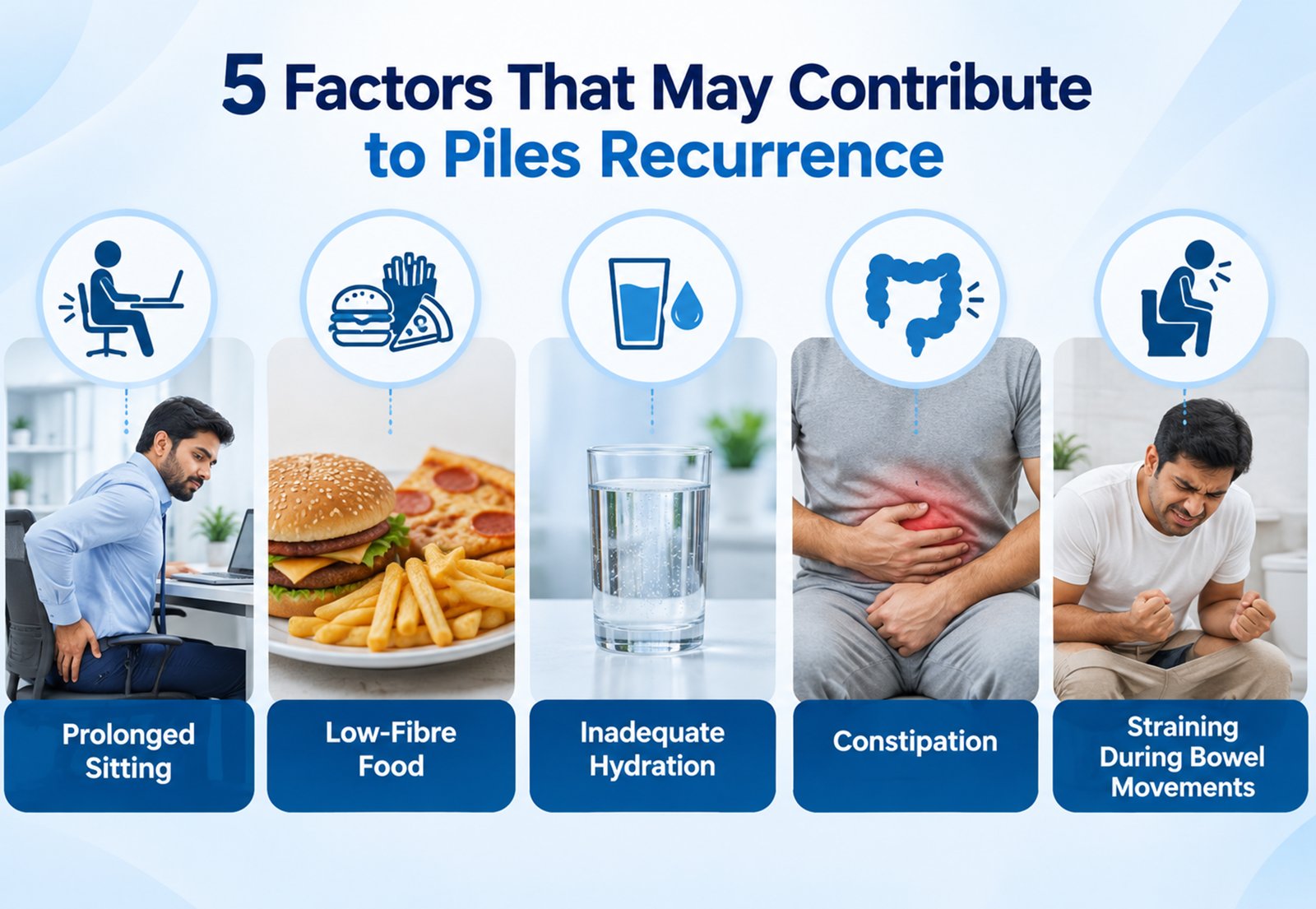
Reason 1: The Cause Was Treated — Not the Conditions That Created It
Treatment removes enlarged tissue, but it does not remove the cause of pressure. If habits remain unchanged, the same stress rebuilds new hemorrhoids.
This is the fundamental mechanism of piles recurrence. The rectum operates as a pressure system. Every time you strain during a bowel movement, pressure inside the pelvic and rectal veins spikes. Repeated pressure spikes over weeks and months cause veins to swell, expand, and eventually prolapse — the sequence that produces haemorrhoids.
Laser treatment, IRC, or surgery removes the swollen vessels. It does not reduce the pressure that caused them. Constipation → Straining → Vein Swelling → Piles → Treatment → Same habits → Piles again. This loop continues until bowel behaviour changes.
Patients who return to exactly the same diet, hydration habits, and toilet behaviour after treatment will, with near certainty, develop new haemorrhoids within 2–5 years.
Reason 2: Dietary Change Was Temporary — Not Permanent
Patients may follow dietary advice — increasing fibre intake and hydration — only during the treatment phase. Once symptoms resolve, they gradually return to their previous habits.
This is the single most consistent pattern in recurrence presentations at Goyal Piles Care Centre. A patient follows the post-procedure diet guide diligently for 4–6 weeks. Symptoms resolve. The urgency fades. Over the following months, the extra dal at lunch disappears, the dalia porridge becomes instant noodles, the two litres of water becomes two cups of chai. Within a year, the stools are hard again, the straining has resumed, and new haemorrhoids are forming.
High-fibre diet and adequate hydration are not a post-treatment protocol — they are a permanent lifestyle change. For 85% of patients who follow post-surgery advice consistently, the results last years. The operative word is consistently — not for six weeks, but permanently.
Reason 3: Straining Was Never Stopped
Straining is the single biggest trigger for haemorrhoidal recurrence. Even successful surgery cannot prevent recurrence if daily straining habits remain unchanged.
Straining happens in two ways:
- Active straining during bowel movements — bearing down forcefully, spending long periods on the toilet, reading or scrolling on the phone while sitting
- Passive straining from constipation — stools that are too hard or too infrequent require effort to pass, even without deliberate bearing down
Both types create the same rectal pressure that caused the original haemorrhoids. The toilet habits that patients had before treatment — sitting for 15 minutes, phone in hand, straining for effect — are the habits that rebuild haemorrhoids after treatment.
The correct toilet habit: respond to the urge within 5–10 minutes, sit for no more than 5 minutes, do not force, and leave if nothing happens. Return when the urge is genuinely present again.
Reason 4: Incomplete Original Treatment
If the original procedure did not fully address all haemorrhoidal columns — either because grading was inaccurate, technique was insufficient, or a lower-grade procedure was applied to a higher-grade condition — residual haemorrhoidal tissue remains. Incomplete treatment, where internal haemorrhoids are missed, is one of the leading causes of apparent recurrence.
This is why the grade confirmed at examination before treatment matters enormously. A patient with Grade III haemorrhoids treated with IRC alone — which is appropriate for Grade I and II only — will have residual haemorrhoidal mass that was never addressed. When symptoms return, it is not truly recurrence — the condition was undertreated from the start.
At Goyal Piles Care Centre, grading is confirmed by proctoscopy at every consultation before any treatment is recommended. The procedure offered is always matched to the confirmed grade — never a less invasive procedure applied to a higher-grade condition for convenience.
Reason 5: Prolonged Sitting Was Not Changed
Even after successful surgery or laser treatment, prolonged sitting for extended periods increases pressure on rectal veins and is a significant recurrence risk factor.
Delhi has a large population of desk workers, drivers, and people with sedentary occupations — all of whom spend 6–10 hours daily in positions that increase pelvic floor pressure. A software engineer in Rohini who sits at a desk for 9 hours, an auto-rickshaw driver from Pitampura who sits for 10 hours, a call centre employee who barely leaves their seat — all are in a physiological position that places continuous low-level pressure on the rectal venous system.
This does not mean treatment is ineffective for these patients. It means that treatment must be accompanied by behavioural change: standing and walking briefly every 45–60 minutes, using a standing desk where possible, and ensuring regular physical activity daily.
New Piles vs Recurring Piles — How to Tell the Difference
Patients often cannot distinguish between a genuine recurrence and a new haemorrhoidal development. In clinical practice, the distinction is made at examination — not from symptoms alone.
Signs that suggest true recurrence:
- Symptoms in exactly the same location as the previous haemorrhoids
- Same grade or higher than the previously treated condition
- Short interval between treatment and return of symptoms (less than 12–18 months)
- No dietary or lifestyle change made after treatment
Signs that suggest new haemorrhoid development:
- Symptoms in a different location or pattern than before
- Longer interval between treatment and new symptoms (3–5 years)
- Lifestyle changes were made but not maintained
- New trigger identified (pregnancy, new medication, change in job/sedentary routine)
Signs that suggest incomplete original treatment:
- Symptoms never fully resolved after the original procedure
- Short symptom-free period of only weeks rather than months
- Original treatment was a lower-grade procedure than the haemorrhoid grade may have required
The management of all three situations begins with a proper clinical examination at Goyal Piles Care Centre — not with repeating the same procedure that was done previously.
Does Laser Treatment Have Lower Recurrence Than Open Surgery?
Yes — with an important qualification.
Recurrence rates after laser haemorrhoidoplasty sit between 5% and 15% at five years — lower than conventional haemorrhoidectomy, but not zero.
Compared to traditional surgery, recurrence rates after laser haemorrhoidoplasty are generally lower when patients follow proper post-procedure care. The precision of laser treatment ensures effective shrinkage of haemorrhoidal tissue.
The qualification: "The laser fixed what was there. It didn't fix why it was there. Patients who sort out their diet and habits after laser rarely come back. The ones who don't are back in two to three years with the same problem."
Laser has a technical advantage — precision targeting of haemorrhoidal tissue with less surrounding tissue disruption. But the lifestyle factors that determine recurrence are identical regardless of whether the original treatment was laser, IRC, stapler, or open surgery.
What Happens When Piles Keep Recurring?
Some patients present to Goyal Piles Care Centre having had piles treated two, three, or more times. The question is not just what to do next — it is why it keeps happening.
If piles repeatedly return, cause frequent bleeding or prolapse, remain painful, or do not improve with appropriate self-care, a proctology evaluation can help identify the cause and determine the appropriate treatment.
At Goyal Piles Care Centre, patients with recurrent piles are assessed with a specific focus on:
What procedure was done before and was it appropriate for the grade? A patient who had IRC for Grade III haemorrhoids has been undertreated, not recurrent.
What lifestyle factors have and have not changed? Dietary fibre, hydration, straining habits, toilet time, and daily activity are all reviewed in detail.
What is the current grade? The haemorrhoids present now may be at a different grade than those treated previously. Treatment is planned for the current grade — not the previous one.
Is there a contributing medical factor? Some patients have underlying conditions — chronic constipation from medication, IBS, or hypothyroidism — that increase recurrence risk regardless of lifestyle effort. These need management alongside haemorrhoid treatment.
The 5 Permanent Changes That Prevent Recurrence

Whether you are coming in for a first treatment, a second, or a discussion about why your symptoms have returned — these five changes are what determine whether piles recur or not.
- High-fibre diet permanently. 25–35 grams of fibre daily, every day — not for six weeks. Dals, oats, dalia, papaya, lauki, fruits, vegetables. See our complete diet guide for piles patients for the full Indian food list.
- Adequate hydration permanently. 2.5–3 litres of water daily. Fibre without water compacts rather than bulking — both are required.
- No straining — ever. Respond to toilet urges within 5–10 minutes. Sit for no more than 5 minutes. No phone on the toilet. If nothing happens, leave and return when the urge is genuinely present.
- Movement every hour. A 5-minute standing and walking break every 45–60 minutes for desk workers and drivers. Reduce continuous pelvic pressure.
- Post-treatment follow-up. Return to Goyal Piles Care Centre for a post-procedure review at the scheduled time. Early identification of any residual or new haemorrhoidal development allows simple treatment rather than waiting until a higher-grade intervention is needed.
If Your Piles Have Returned — What to Do Now
Do not delay seeing a specialist because you feel embarrassed that your piles have returned or assume "surgery did not work." In most cases, recurring piles are a treatable condition — often with a simpler procedure than the original treatment if caught early.
At Goyal Piles Care Centre, recurring piles patients are assessed with the same structured examination as all new patients. Your grade is confirmed, the reason for recurrence is identified, and the appropriate next treatment — if any is needed — is recommended with full clinical reasoning.
476 verified Google reviews at 4.7 stars. Global Excellence Award 2019 — Best Laser Centre in North India.
📍 D-12/182, First Floor, Sector 8, Rohini, Delhi – 110085 Near Rohini East Metro Station Gate 2 | Opposite Metro Pillar No. 393 📞 Call or WhatsApp: +91-9999333166 Monday to Saturday | 9:30 AM to 1:30 PM
→ Diet after piles treatment — the permanent change guide → IRC treatment in Rohini → Piles treatment without surgery → Difference between piles, fissure and fistula
This article is for informational purposes only. Please consult a qualified medical professional for diagnosis and personalised treatment.
