IRC Treatment for Piles in Rohini, Delhi — What Is It, Does It Hurt, and How Many Sessions Will You Need?
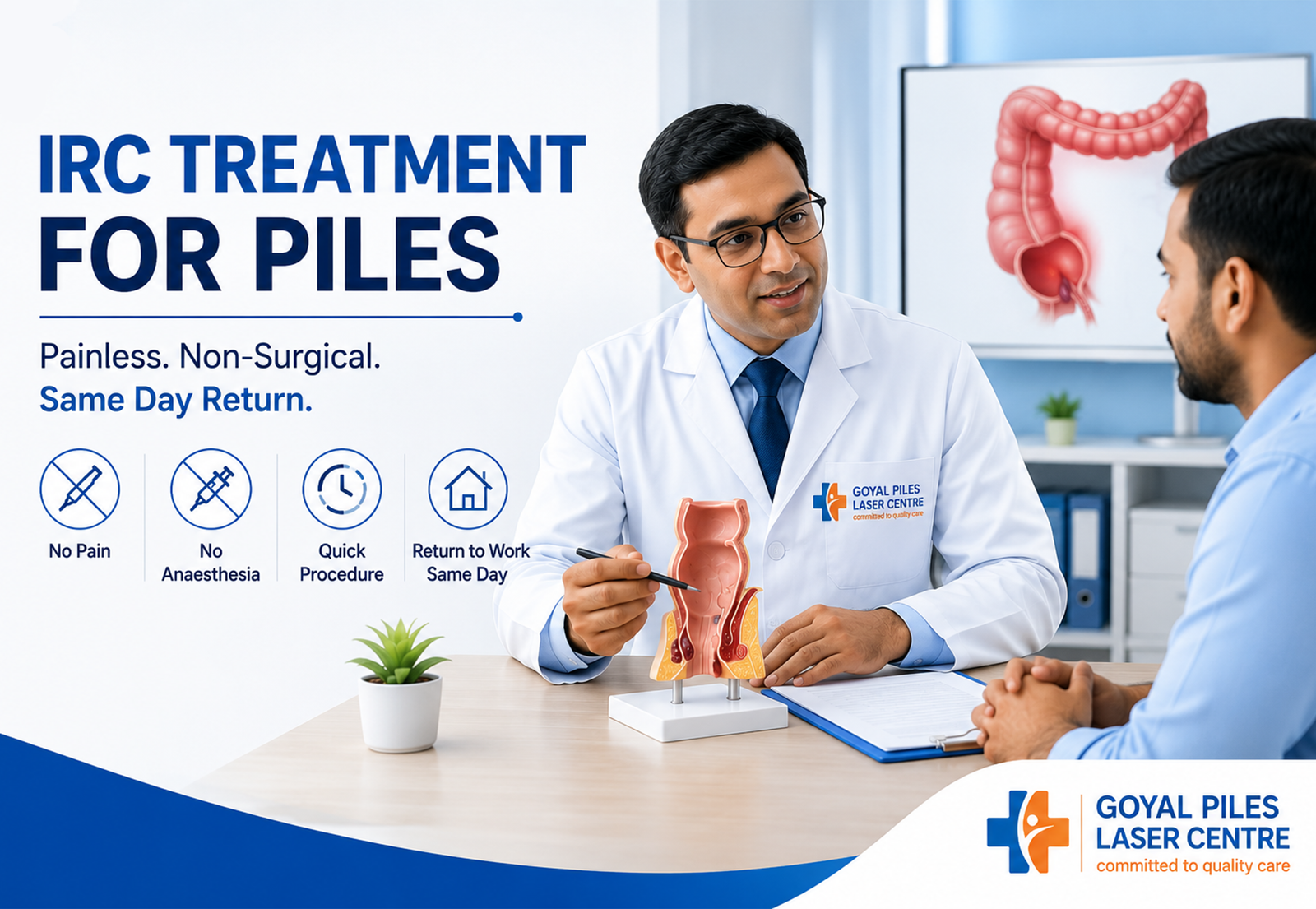
If you have been told you have Grade I or II piles and someone has suggested IRC as a treatment option, you have probably Googled it — and found that most explanations are either too technical to make sense or too vague to actually help you decide.
IRC stands for Infrared Coagulation. It is the most commonly performed non-surgical piles procedure at Goyal Piles Laser Centre in Rohini, and it has been for decades. This article covers everything you actually need to know before you book: how it works, whether it hurts, how many sessions you will need, what the procedure involves minute by minute, and what it costs in Rohini in 2026.
What Is IRC — The Plain-Language Explanation
Infrared Coagulation uses a brief, focused pulse of infrared light — delivered through a small probe — to create a tiny controlled scar at the base of a haemorrhoid. This scar blocks the blood vessels supplying the haemorrhoidal tissue. Without its blood supply, the pile gradually shrinks and, over the following one to two weeks, detaches and passes away naturally during bowel movements.
Think of it as a very targeted, very brief application of heat — similar in concept to cauterising a wound to stop bleeding, except here the heat is applied to cut off the pile's blood supply rather than to remove it.
The reason IRC is essentially painless is anatomical. The probe is applied just above the dentate line — the boundary inside the anal canal that separates pain-sensitive tissue below from the mucosa above, where pain nerve endings are minimal. A clinical study confirmed that IRC is a non-surgical, ambulatory, painless, and bloodless procedure when performed correctly on an OPD basis.
IRC does not cut, stitch, or remove tissue. It causes the haemorrhoid to resolve on its own by interrupting its blood supply.
.png)
Who Is IRC Suitable For?
IRC is a highly effective treatment — but only for specific grades and presentations.
IRC is the right choice for:
- Grade I internal haemorrhoids — bleeding without prolapse
- Grade II internal haemorrhoids — prolapse that self-reduces after bowel movement
- Patients whose main symptom is painless rectal bleeding
- Elderly patients or those for whom anaesthesia carries a risk
- Patients on anticoagulant medications
- Anyone who needs to return to work the same day
IRC is not suitable for:
- Grade III or IV haemorrhoids — the prolapsed tissue mass is too large
- External haemorrhoids — IRC works on internal tissue only
- Acutely thrombosed haemorrhoids
- Active perianal infection or inflammatory bowel disease
The most important point: IRC suitability is confirmed by examination, not by self-assessment. Grade is only accurately established through a proper clinical examination.
What Actually Happens During Your IRC Session
Before you arrive
No fasting required. No bowel preparation or enema is needed for IRC. Wear comfortable clothing. You can drive yourself to and from the clinic.
If you are on blood thinners such as warfarin, aspirin, or newer anticoagulants, mention this when booking. IRC is generally safe for anticoagulated patients but Dr. Sushil Goyal will confirm this during your consultation.
At the clinic
You will be asked to lie on your side on the examination table in a comfortable position. A small proctoscope — a lighted instrument approximately the width of a finger — is gently inserted into the anal canal. This allows Dr. Goyal to directly visualise the haemorrhoidal tissue and the dentate line. The insertion takes a few seconds and causes mild pressure rather than pain in most patients.
The procedure itself
The IRC probe is applied to the base of each internal haemorrhoid — the area just above the dentate line — for approximately 1 to 1.5 seconds per application. You may feel a brief sensation of warmth or mild pressure at the point of contact. For a patient with two or three internal haemorrhoids, the active part of the procedure takes 5 to 10 minutes in total.
Immediately after
You can get up, get dressed, and leave. There is no recovery room, no observation period, and no need for anyone to drive you. Most patients drive themselves home or return to their office directly from the clinic.
The following days
The treated haemorrhoidal tissue dries out and begins to shrink over the next 7 to 14 days. You may notice a small amount of spotting or discharge during this period — this is a normal part of the healing process. Mild aching or a sense of heaviness is possible for 24 to 48 hours and is managed with standard pain relief if needed. Warm sitz baths for 10 minutes, two or three times a day, help with any discomfort and support healing.
Does IRC Hurt? — An Honest Answer
For the vast majority of patients, IRC causes no significant pain during the procedure itself.
The clinical reason is straightforward: the probe contacts tissue above the dentate line, where the mucosa has very few pain-sensitive nerve endings. This is the same reason many patients with Grade I internal haemorrhoids do not even know they have them until they bleed.
Post-procedure, mild discomfort or a dull ache is possible for one to two days. This responds well to paracetamol and warm sitz baths. It is categorically different from the sharp burning pain of a fissure, and significantly less than post-operative pain from surgical procedures.
The exception is patients who have concurrent external haemorrhoids or a fissure. External tissue and fissure tissue are pain-sensitive. If Dr. Sushil Goyal identifies these during your examination, he will explain what sensation to expect before proceeding.
How Many IRC Sessions Will You Need?
Grade I piles, single haemorrhoid: Often resolved in one session.
Grade I piles, two or three haemorrhoids: The number of visits depends on the examination findings and the number of haemorrhoids being treated.
Grade II piles: Generally two to three sessions, depending on size and the number of columns involved.
Why are multiple haemorrhoids not all treated in one session? Treating all columns simultaneously increases post-procedure discomfort and temporarily narrows the anal canal during healing. Staging treatment across two to three visits produces better patient comfort and equivalent outcomes.
Between sessions, you return to your full normal routine — there is no recuperation period between IRC visits. Most patients find the scheduling straightforward: a 10-minute clinic visit once every few weeks.
If symptoms return after a completed course, recurrence is possible — particularly if the underlying causes (constipation, low fibre diet, straining) have not been addressed. A further IRC course may be appropriate, or if the condition has progressed, Dr. Sushil Goyal may recommend laser haemorrhoidoplasty as a more definitive option.
IRC vs Laser — A Simple Comparison
Patients often ask how IRC compares with the other non-surgical piles procedures available at Goyal Piles Laser Centre.
| Feature | IRC | Laser (LHP) | Laser Treatment |
|---|---|---|---|
| Best for | Grade I–II | Grade II–III | Grade I–II |
| Pain during procedure | None to minimal | Minimal | Mild pressure |
| Sessions needed | 1–3 | Usually 1 | 1–3 |
| Return to work | Same day | 1–2 days | Same day |
| Anaesthesia required | None | Local or Spinal | None |
| Cost at Goyal Piles, Rohini | ₹30,000–₹35,000 | ₹50,000–₹60,000 | Varies |
| Covered by insurance | Rarely (OPD) | Usually (surgical) | Rarely (OPD) |
IRC and laser treatment are selected according to the patient's grade and examination findings. Laser treatment may be recommended where IRC would be insufficient.
Before and After IRC — What to Do
.png)
Before your appointment:
- No fasting or diet changes required
- No bowel preparation needed
- Tell Dr. Goyal if you are on blood thinners
- Wear comfortable clothing
- You can drive yourself
After your IRC session:
- Return to desk work immediately — same day
- Warm sitz baths 2–3 times daily for the first week
- Eat a high-fibre diet and drink at least 2–3 litres of water daily
- Avoid heavy lifting and strenuous exercise for 48–72 hours
- Mild spotting or discharge over 7–14 days is normal healing
- Contact the clinic if you experience heavy bleeding, severe pain, or fever
Cost of IRC Piles Treatment in Rohini, Delhi (2026)
IRC treatment at Goyal Piles Laser Centre is priced at ₹30,000–₹35,000 — all-inclusive.
This includes the procedure itself, the proctoscope examination, and one follow-up assessment. Pre-procedure blood tests and post-procedure medication, if clinically required, are additional.
Insurance note: Insurance coverage depends on your policy. Confirm the coverage and required documents with your TPA before booking.
Frequently Asked Questions About IRC Treatment
Q: How long does each IRC session take at Goyal Piles Laser Centre?
The active procedure takes 5–10 minutes, depending on the number of haemorrhoids being treated. Including the examination and getting ready, the full visit is typically 20–30 minutes. You leave immediately after — there is no recovery observation period.
Q: Can I eat normally before and after IRC?
Yes to both. No dietary restrictions are required before IRC, and you can eat normally afterwards. We recommend a high-fibre diet and plenty of water post-procedure to keep stools soft during the healing period.
Q: Is IRC suitable for diabetic patients or elderly patients?
Yes — IRC's absence of anaesthesia makes it particularly well-suited for elderly patients and those with comorbidities like diabetes or cardiac conditions, where anaesthesia carries a higher risk. Dr. Sushil Goyal will review your complete health history before recommending IRC.
Q: Can IRC treat Grade III piles?
IRC is not suitable for every Grade III presentation. Only an examination confirms your grade and whether laser treatment is appropriate.
Q: Will IRC completely cure my piles?
IRC resolves the current haemorrhoidal disease in the majority of patients. However, if the underlying causes of piles (constipation, low-fibre diet, prolonged sitting, straining) are not addressed, new haemorrhoids may develop. Dr. Sushil Goyal provides dietary and lifestyle guidance post-treatment to reduce recurrence.
Book Your IRC Appointment at Goyal Piles Laser Centre
IRC has been performed at Goyal Piles Laser Centre since the clinic opened in 1989. Dr. Sushil Goyal — MBBS, FCGP, 37 years of proctology practice — has performed IRC across all patient profiles: young patients, elderly patients, patients on anticoagulants, and those with multiple comorbidities.
The procedure is available without a referral. Call or WhatsApp to book an appointment and bring a description of your symptoms. Dr. Goyal will examine your condition, confirm your grade, and tell you whether IRC is appropriate — or recommend a more suitable option if it is not.
📍 D-12/182, First Floor, Sector 8, Rohini, Delhi – 110085
Near Rohini East Metro Station Gate 2 | Opposite Metro Pillar No. 393
📞 Call or WhatsApp: +91-9999333166
Monday to Saturday | 9:30 AM to 1:30 PM
→ Full piles treatment options guide → Laser piles treatment cost in Delhi → Book an appointment
This article is for informational purposes only and does not constitute medical advice. Please consult a qualified medical professional for diagnosis and personalised treatment recommendations.
