Piles, Fissure or Fistula — What's the Difference and Which Condition Do You Have?
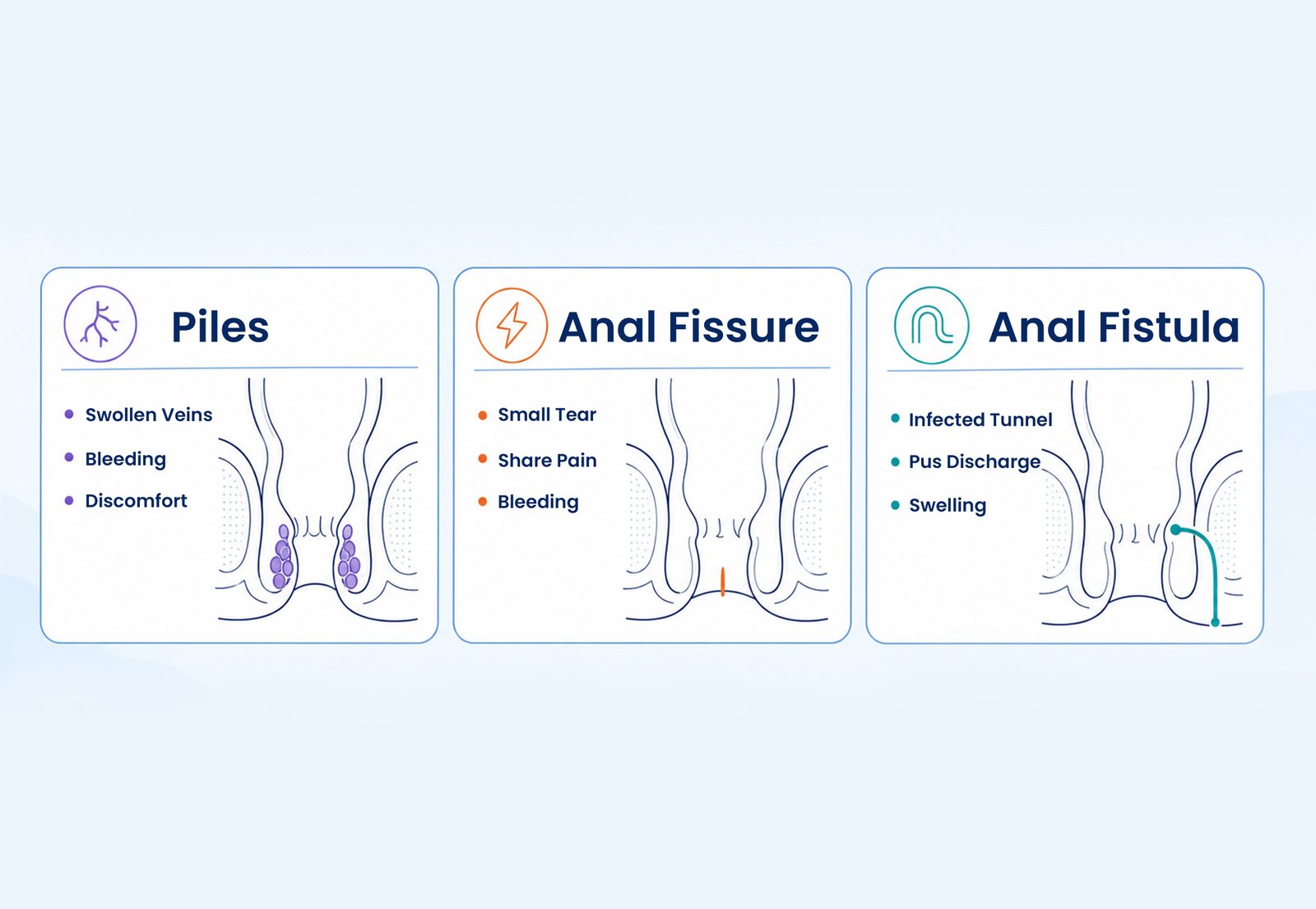
Rectal bleeding. Pain after a bowel movement. An uncomfortable feeling that something is wrong in a place you'd rather not discuss with anyone. If you have been experiencing any of these symptoms, you have probably searched for answers — and come across three names that keep appearing together: piles, fissure, and fistula.
They affect the same area of the body. They share some symptoms. And they are frequently confused with each other — sometimes even by patients who have been self-treating the wrong condition for weeks.
But piles, fissure, and fistula are three entirely different conditions. They have different causes, different symptoms, different levels of urgency, and different treatments. Understanding the distinction is the first step toward getting the right help. This article gives you the clearest possible comparison — plus a practical self-assessment section to help you identify which condition you are most likely dealing with before you see a doctor.
Quick Summary — What Each Condition Actually Is
| Condition | What it is |
|---|---|
| Piles (Haemorrhoids) | Swollen, enlarged blood vessels inside the rectum or around the anus |
| Anal Fissure | A small tear or cut in the delicate lining of the anal canal |
| Anal Fistula | An abnormal infected tunnel connecting the inside of the anal canal to the skin surrounding the anus |
The single most useful way to think about the difference: piles are vascular, fissures are structural, and fistulas are infectious. Three different problems — in the same location.
Understanding Each Condition in Detail
Piles (Haemorrhoids) — Swollen Veins
Haemorrhoids — commonly called piles or bawasir — are clusters of blood vessels, tissue, and muscle that exist naturally in the anal canal. They become a problem when these vessels become engorged, inflamed, or pushed out of position due to increased pressure.
Internal piles develop inside the rectum, above the dentate line. Because this area has few pain nerve endings, internal piles are often completely painless — but they bleed. Bright red blood during or after a bowel movement, on tissue paper or in the toilet bowl, is typically the first sign.
External piles develop below the dentate line, in tissue rich with nerve supply. These can be painful, particularly when a blood clot forms inside (thrombosed haemorrhoid), causing sudden, severe pain.
Common causes include chronic constipation, straining during bowel movements, low-fibre diet, prolonged sitting, pregnancy, and obesity. Piles are graded from Grade I (bleeding only, internal) to Grade IV (permanently prolapsed) — the grade determines the appropriate treatment.
Anal Fissure — A Tear in the Lining
An anal fissure is a small tear in the lining of the anal canal — similar in concept to a paper cut, but in a location that stretches every time you pass stool.
What makes a fissure so distinctively painful is not just the tear itself. When the anal lining tears, the internal sphincter muscle goes into protective spasm. This spasm restricts blood flow to the area and causes burning, throbbing pain that continues for one to three hours after passing stool. This prolonged post-defecation pain is one of the most reliable indicators that a fissure — not piles — is the problem.
Fissures can be acute (under six weeks, more likely to heal with conservative treatment) or chronic (over six weeks, with hardened edges and a sentinel skin tag that prevent healing). Common causes include passing large or hard stools, chronic constipation, chronic diarrhoea, childbirth, and low-fibre diet.
Anal Fistula — An Infected Tunnel
A fistula is the most complex of the three conditions — and the one that most reliably requires medical or surgical treatment.
There are small glands just inside the anal canal that produce mucus. Occasionally one of these glands gets blocked. Bacteria build up, an abscess forms, and the area becomes acutely infected — painful, swollen, and sometimes feverish. If this abscess is not adequately drained, it burrows outward through the surrounding tissue and eventually breaks through the skin near the anus. The tract it leaves behind is the fistula.
The result is a small tunnel connecting the anal canal to an opening in the skin, through which pus and bloody fluid discharge intermittently. The external opening may look like a small pimple or sore near the anus that never fully heals.
Unlike piles and fissures, an anal fistula almost never heals on its own. The tunnel remains because the infected gland at its internal origin continues to harbour bacteria. Without treatment, symptoms recur — repeated abscesses, discharge, pain, and skin irritation.
The Full Comparison — Side by Side
| Feature | Piles | Fissure | Fistula |
|---|---|---|---|
| What it is | Swollen blood vessels | Tear in anal lining | Infected tunnel to skin |
| Main symptom | Bleeding (usually painless) | Severe burning pain | Pus or bloody discharge |
| Pain pattern | Mild or absent (internal) | During + 1–3 hrs after stool | Constant, not only during toilet |
| Bleeding | Bright red, dripping or splashing | Small smear on tissue | Bloody or pus-containing discharge |
| Swelling or lump | External pile or prolapse | Possible skin tag | Opening or boil near anus |
| Heals without treatment | Sometimes (Grade I–II) | Sometimes (acute, under 6 wks) | Almost never |
| Primary cause | Pressure on rectal veins | Trauma from hard stool | Anal abscess / gland infection |
| Fever | No | No | Possible (abscess stage) |
| Needs surgery | Not always | Not always | Almost always |
Which Condition Do You Have? A Self-Assessment Guide
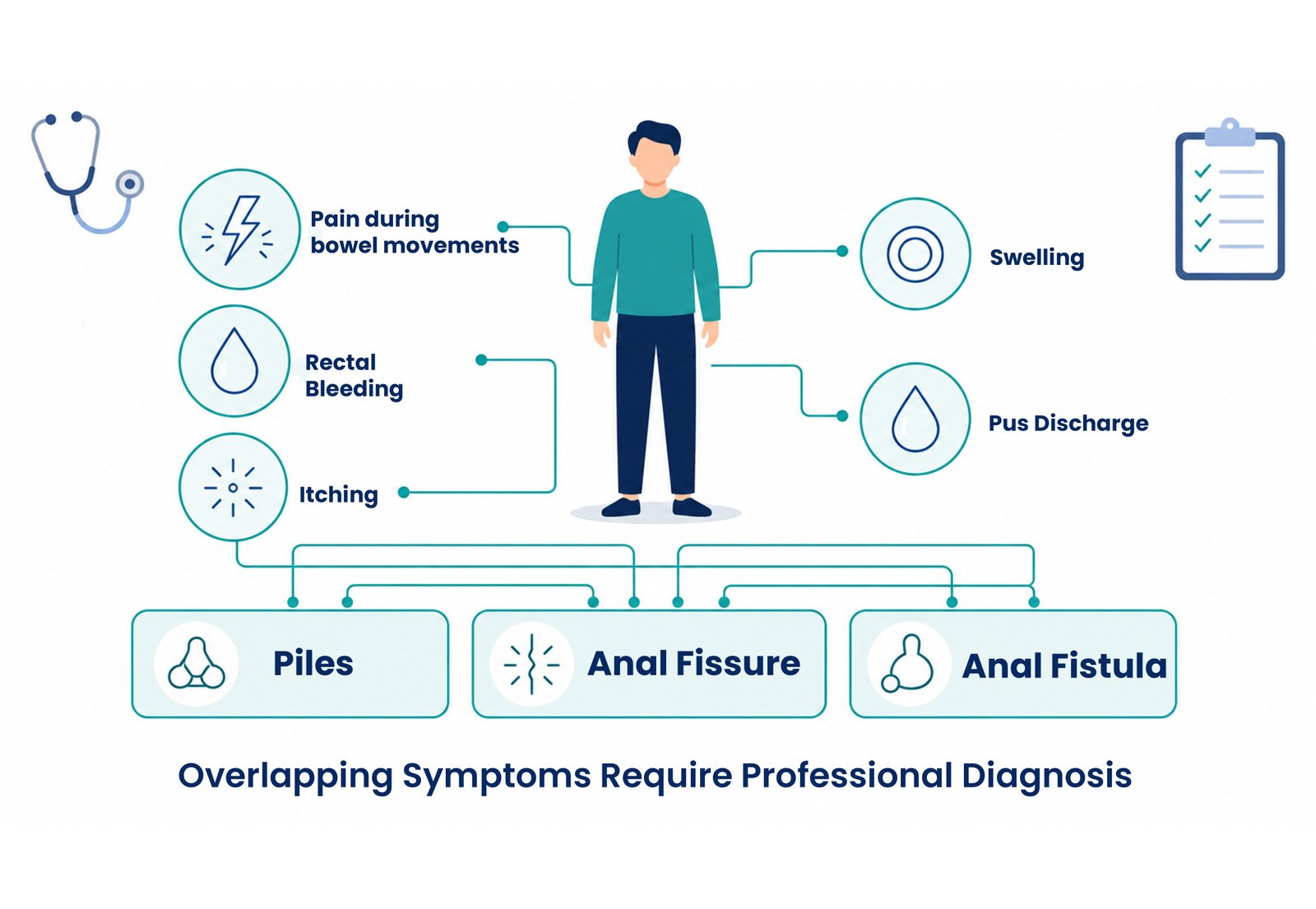
This is the question every patient actually needs answered — and no article covers it directly. Work through these four questions based on your symptoms. This is a guide only — a proper clinical examination is the only accurate way to confirm a diagnosis.
Question 1: Is the bleeding painless?
Bleeding with minimal or no pain during or after the bowel movement = likely piles.
Bleeding accompanied by sharp burning pain = likely fissure.
Discharge that is pus-coloured, foul-smelling, or mixed with blood from a sore near the anus = likely fistula.
Question 2: How long does any pain last after passing stool?
Pain resolves within minutes = possibly mild piles (external).
Burning or throbbing lasts one to three hours = almost certainly fissure.
Pain is present throughout the day, not specifically after bowel movements = likely fistula.
Question 3: Is there any discharge near the anus?
No discharge, just blood = piles or fissure.
Pus, fluid, or persistent wetness near the anus from a small opening = fistula until proven otherwise.
Question 4: Have you recently had a painful swelling near the anus that burst or was drained?
Yes = you may have had an anal abscess, and a fistula may have developed from it.
No = this makes fistula less likely (though not impossible).
If your symptoms overlap: many patients have piles and a fissure simultaneously — hard stools that cause straining also traumatise the anal lining. This is common and does not mean you have two separate problems requiring two separate treatments.
Can One Condition Turn Into Another?
This is one of the most common fears patients bring to a consultation — and one of the most frequently misunderstood.
Can a fissure turn into a fistula? No. A fissure is a tear in the anal lining. It does not transform into a fistula. A fissure and a fistula develop through completely different mechanisms.
What CAN turn into a fistula? An anal abscess can develop into a fistula if it is not properly treated. The abscess is the precursor, not the fissure.
Can piles turn into a fistula? No. Piles are swollen blood vessels and do not progress into fistulas. They can worsen in grade, but that is a different progression entirely.
Can you have more than one condition at the same time? Yes — piles and fissure together are common. Fissure and fistula together are less common but possible, especially in Crohn's disease. All three simultaneously is rare but does occur. This is why an examination matters — symptoms alone do not reliably distinguish overlapping conditions.
Treatment — What Each Condition Requires
Treating Piles
Grade I and early Grade II piles respond well to conservative management — dietary changes, hydration, and Infrared Coagulation (IRC). Grade II and III piles may be treated with laser treatment — a day-care procedure with return to work in 1–2 days. Grade III–IV cases require an examination-based treatment plan.
The majority of patients do not need open surgery. Learn more about piles treatment options at our Rohini clinic.
Treating Fissure
Acute fissures (under six weeks) are treated conservatively — fibre, hydration, warm sitz baths, and GTN or diltiazem ointment to relax the sphincter. This resolves approximately 50–70% of cases. Chronic fissures require laser treatment (day-care, no open wound, return to desk work in 2–3 days) or, in complex cases, open lateral internal sphincterotomy (LIS). See our complete guide to fissure treatment in Rohini.
Treating Fistula
Fistulas almost never resolve without treatment. At Goyal Piles Laser Centre, laser fistula surgery is the primary approach — the laser seals the fistula tract from within, with precision that minimises risk to the surrounding sphincter muscle. Depending on the tract's depth and complexity, fistulotomy or the LIFT procedure may also be considered. Read more about fistula treatment in Rohini.
When to See a Doctor — Urgency Guide
See a doctor within 1–2 days if:
- Heavy rectal bleeding that is not slowing down
- Fever with a swollen, painful lump near the anus
- Severe pain preventing normal daily activity
- Pus or foul-smelling discharge from near the anus
See a doctor within 1–2 weeks if:
- Symptoms have not improved after one week of dietary changes and home care
- Bleeding is recurring after bowel movements
- A lump is not reducing
- Burning pain is persisting for hours after each bowel movement
Important note on self-diagnosis: rectal bleeding, while most commonly caused by piles or fissure, can also be a symptom of colorectal polyps, inflammatory bowel disease, and — rarely — colorectal malignancy. A proper examination confirms which condition you have and rules out the others.
All Three Conditions Treated at One Clinic in Rohini, Delhi
At Goyal Piles Laser Centre, Sector 8, Rohini, Dr. Sushil Goyal has been diagnosing and treating piles, fissures, fistulas, and pilonidal sinus conditions since 1989 — 37 years at the same clinic, with the same standard of care.
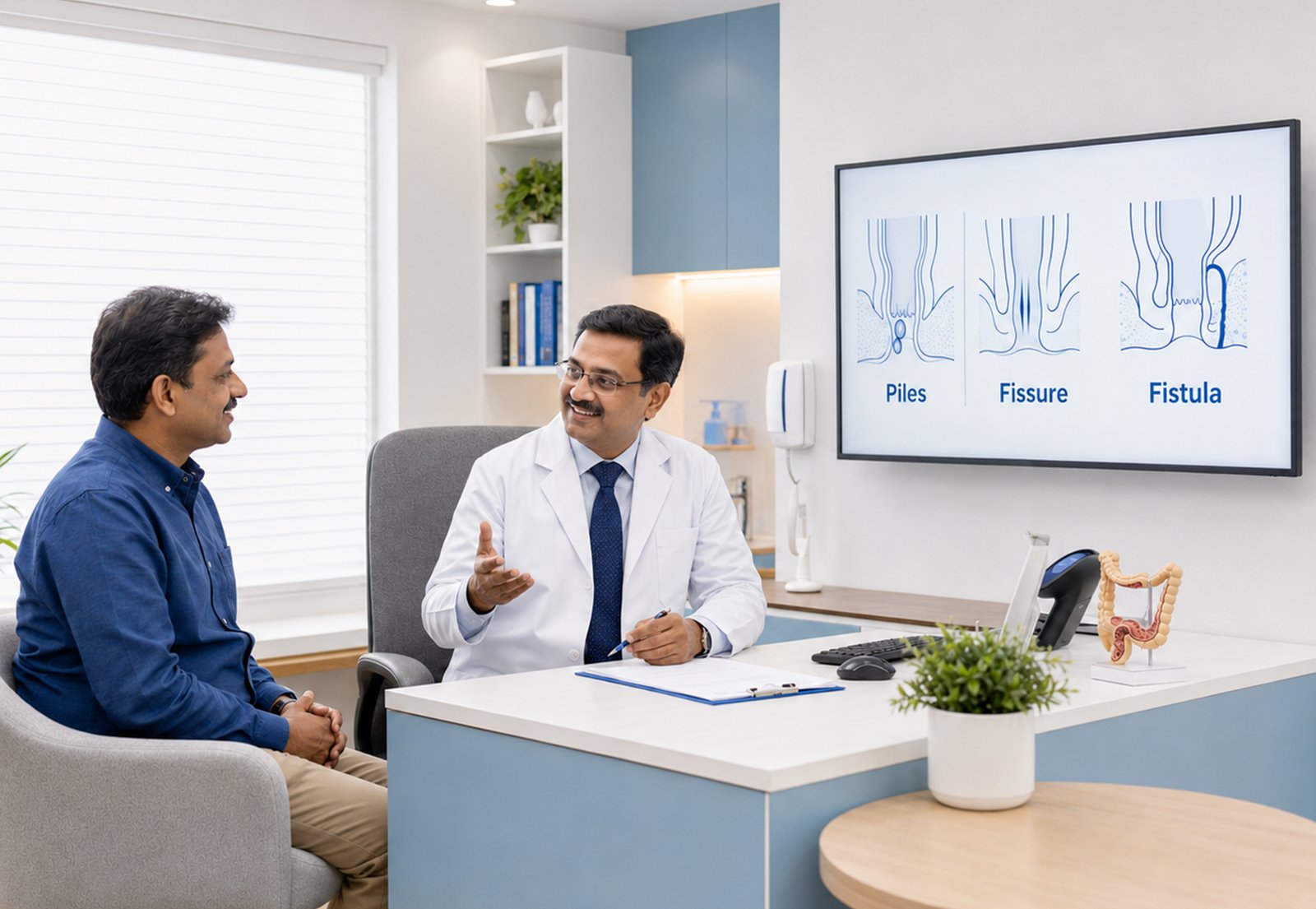
Many patients arrive unsure of their diagnosis. The first consultation always begins with a proper clinical examination — not a treatment recommendation based on symptoms alone. Dr. Goyal will assess your condition, confirm whether you have piles, fissure, fistula, or a combination, explain your grade or severity, and outline the most appropriate treatment options for your specific case.
The clinic was awarded the Global Excellence Award 2019 — Best Laser Centre in North India, presented by Madhuri Dixit, and has successfully treated over 1 lakh patients across Rohini, Pitampura, Shalimar Bagh, Prashant Vihar, and across North and Northwest Delhi.
Your first consultation is free. No commitment required on the day.
📍 D-12/182, First Floor, Sector 8, Rohini, Delhi – 110085
Near Rohini East Metro Station Gate 2 | Opposite Metro Pillar No. 393
📞 Call or WhatsApp: +91-9999333166
Frequently Asked Questions
Q: Which is more painful — piles, fissure, or fistula?
A: Anal fissure is typically the most acutely painful of the three, due to burning sphincter spasm that persists for one to three hours after each bowel movement. Internal piles are often painless. Fistulas cause persistent, constant pain that becomes more severe when an abscess develops.
Q: Can I have both piles and a fissure at the same time?
A: Yes — this is common. Constipation and straining that cause piles can also traumatise the anal lining and cause a fissure. Both conditions can be assessed and confirmed in a single consultation.
Q: Does a fissure turn into a fistula if untreated?
A: No — this is a common misconception. A fissure does not transform into a fistula. A fistula develops from an infected anal abscess, which is a completely separate process.
Q: Do all three conditions require surgery?
A: No. Grade I–II piles and acute fissures may resolve with conservative care or simple outpatient procedures. Fistulas almost always require proper medical or surgical treatment.
Q: Is the first consultation at Goyal Piles Laser Centre free?
A: Yes. Your first consultation with Dr. Sushil Goyal is free of charge. He will examine your condition, confirm your diagnosis, and explain your treatment options with no obligation to proceed on the day.
The Bottom Line
Piles, fissure, and fistula are three distinct conditions that affect the same area of the body but differ fundamentally in what they are, what causes them, and how they need to be treated.
Piles are swollen blood vessels — managed conservatively or with minimally invasive procedures in most cases. Fissures are tears in the anal lining — treatable without surgery in many patients when caught early. Fistulas are infected tunnels — and almost always require proper medical treatment to resolve.
If you have been dealing with any of these symptoms and are unsure of your diagnosis, the most productive next step is a proper examination. A ten-minute consultation will tell you more than weeks of self-treatment.
This article is for general informational purposes only and does not constitute medical advice. Please consult a qualified medical professional for diagnosis and personalised treatment.
