Thrombosed Haemorrhoid — Sudden Severe Pain Near the Anus Explained
You went to bed feeling normal. You woke up — or came home from work — with a sudden, very painful, hard lump near the anus. It appeared seemingly overnight. Sitting is agonising. Walking is uncomfortable. You are not sure what it is or whether you need to go somewhere urgently.
In most cases, what you are experiencing is a thrombosed external haemorrhoid — a blood clot that has formed inside an external haemorrhoidal vein. Thrombosed haemorrhoids occur when a blood clot accumulates inside an external haemorrhoid, resulting in a painful, swollen bump close to the anus.
The good news: it is not dangerous. Thrombosed haemorrhoids are not dangerous, and treatment is widely available. The important news: there is a treatment window — the first 48–72 hours — during which the fastest and most effective relief is available. After that window, the approach changes. This article tells you everything you need to know, clearly and quickly.
What Is a Thrombosed Haemorrhoid?
External haemorrhoids are blood vessel clusters located just outside the anal canal, under the sensitive perianal skin. When a blood clot forms suddenly inside one of these vessels, it causes it to swell rapidly — producing a firm, tender lump that was not there before.
Acute thrombosed external haemorrhoids are often extremely painful. The pain is caused by two factors working together: the sudden pressure of the clot stretching the haemorrhoidal vein from within, and the inflammation of the highly pain-sensitive perianal skin overlying it. Unlike internal haemorrhoids — which are above the dentate line where there are fewer pain nerves — external haemorrhoids sit in tissue that has full pain sensation.
When thrombosed, haemorrhoids may be very painful, though this pain typically resolves in two to three days. Understanding this timeline is key to making the right decision about treatment.
What Does a Thrombosed Haemorrhoid Feel Like?
The onset is typically sudden. Many patients describe waking up with the pain, or noticing it after a bowel movement, a period of prolonged sitting, heavy lifting, or physical exertion. Unlike the gradual discomfort of ordinary haemorrhoids, the pain of thrombosis arrives quickly.
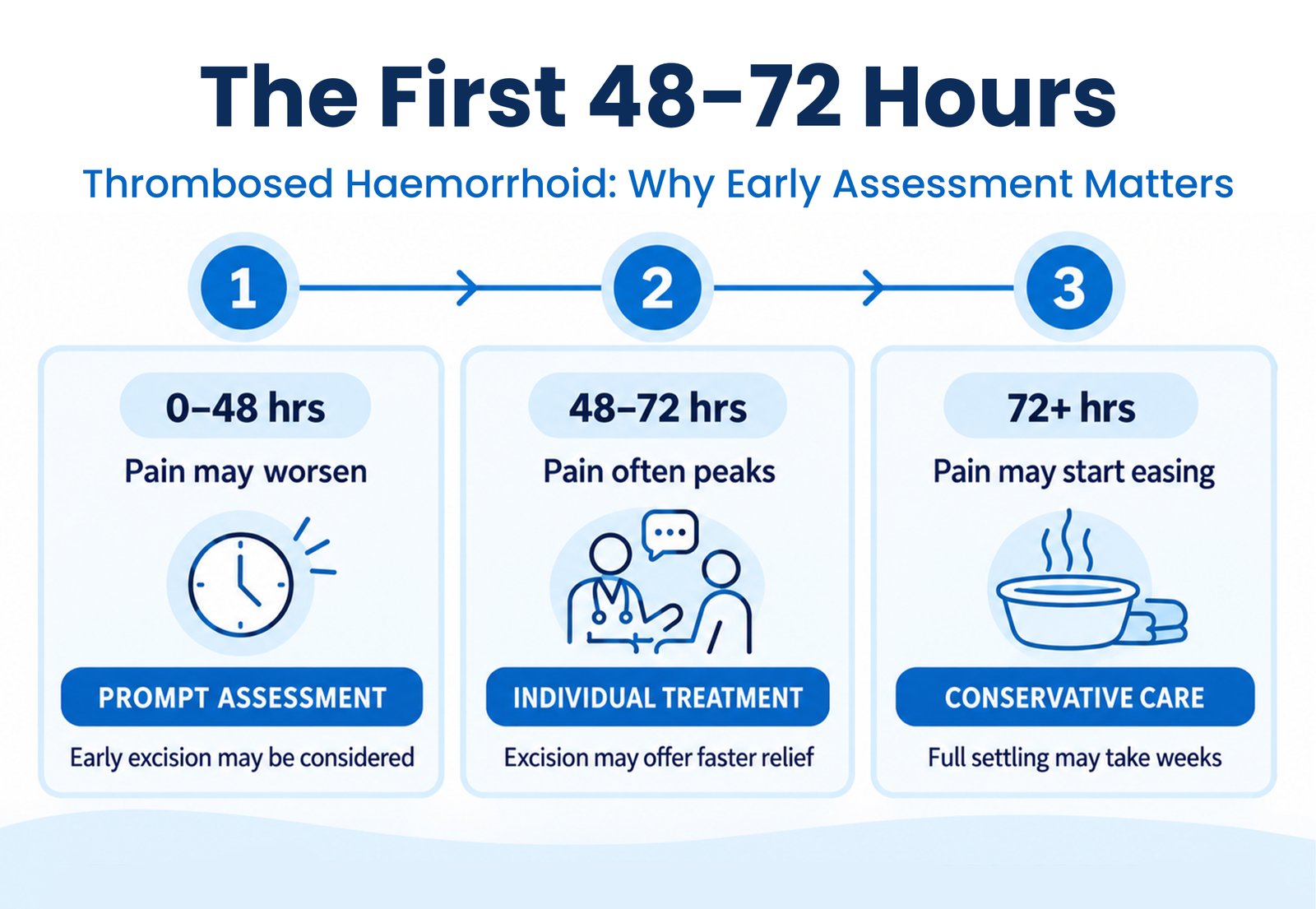
The pain is severe at the start. Sudden, severe pain can indicate a thrombosed haemorrhoid. The first 24–48 hours are typically the most painful. Pain tends to peak at around 48 hours and then gradually decreases as the clot begins to organise and the acute inflammation subsides.
A firm, tender lump is visible and palpable. The thrombosed haemorrhoid is usually a distinct, firm, bluish-purple swelling at the anal margin. It does not retract inside the way an internal prolapsed haemorrhoid does — it is external and stays external.
Swelling and skin tightness. The overlying skin becomes stretched and inflamed. This causes additional tenderness beyond the clot itself.
Sitting and walking are painful. Pressure on the area — from any direction — aggravates the pain. Many patients find the first day or two genuinely disabling.
What Causes a Thrombosed Haemorrhoid?
The precise trigger for blood clot formation inside an external haemorrhoid is not always identifiable. The specific reason some patients develop a thrombosed haemorrhoid and some do not is not fully understood. However, several common precipitating factors are consistently seen at Goyal Piles Care Centre:
A single episode of significant straining — an unusually difficult bowel movement, constipation after a change in diet or travel, or straining during heavy physical work or exercise. The sudden pressure spike causes the vessel to fill rapidly and clot.
Prolonged sitting — long journeys by car, flight, or train; an unusually sedentary day; or a prolonged sitting episode on the toilet. Sustained pelvic pressure without the relief of movement increases the risk.
Diarrhoea — repeated urgent bowel movements with straining cause repeated pressure spikes and irritation of external haemorrhoidal vessels.
Pregnancy and delivery — both the pressure of the uterus and the straining of delivery are well-established triggers. Thrombosed external haemorrhoids are particularly common in the first weeks after childbirth.
Physical exertion — heavy lifting, intense exercise, or manual labour that involves Valsalva manoeuvre (bearing down while holding breath) can precipitate thrombosis.
The 48–72 Hour Window — Why Timing Matters
This is the most clinically important information in this article.
Within the first 48–72 hours of a thrombosed external haemorrhoid, a minor surgical procedure — excision or incision and drainage under local anaesthetic — can remove the clot and provide dramatic, often near-immediate pain relief. If a thrombosed external haemorrhoid is diagnosed early, a doctor may make a small incision to drain the clot.
The procedure takes approximately 10–15 minutes at Goyal Piles Care Centre under local anaesthetic. Most patients experience significant relief within hours of the procedure. It is done as an outpatient appointment — no hospital admission, no general anaesthetic, no major surgery.
After 72 hours, the clot begins to organise and the acute inflammatory phase starts to subside naturally. The rationale for surgical drainage weakens as the clot becomes harder to evacuate completely and the natural resolution process has already begun. At this stage, conservative management — sitz baths, pain relief, stool softeners — is typically the appropriate approach, with the swelling gradually reducing over 1–3 weeks.
Thrombosed haemorrhoids that present after 72 hours require medical attention, but the approach shifts to supportive care as natural resolution is already underway.
The bottom line: If you have developed a sudden, very painful lump near the anus — and it has been less than 48–72 hours — contact Goyal Piles Care Centre immediately on +91-9999333166. Do not wait to see if it improves on its own. The treatment window is short, and early intervention produces the best outcome.
Treatment Options at Goyal Piles Care Centre, Rohini
Within 48–72 Hours — Excision or Incision and Drainage
Under local anaesthetic, Dr. Sushil Goyal makes a small incision to evacuate the clot and decompress the thrombosed haemorrhoid. The procedure provides rapid relief from the pressure and pain caused by the clot. Most patients describe significant improvement within hours.
- Local anaesthetic injection to the area — the only uncomfortable moment
- Procedure: 10–15 minutes
- Same-day return home
- Mild soreness for 2–3 days after the procedure
- Sitz baths and prescribed pain relief for the healing period
After 72 Hours — Conservative Management
If you present after the optimal window, the approach is conservative management to support natural resolution:
Warm sitz baths — 10–15 minutes, 3–4 times daily. Warm water increases blood flow to the area and reduces inflammation. The single most effective conservative measure for thrombosed haemorrhoid pain.
Pain relief — prescribed anti-inflammatory and analgesic medication from Dr. Sushil Goyal, appropriate to your health profile.
Stool softeners — to ensure soft, easy stools during the healing period without any straining that would aggravate the thrombosis.
High-fibre diet and hydration — immediately, to prevent constipation during the recovery period and reduce the risk of triggering a further thrombosis.
Cold compress initially, then warm — in the first 24 hours, a cold pack applied to the area briefly can reduce acute swelling. After the first 24 hours, warm sitz baths are more appropriate.
Activity modification — minimise prolonged sitting, use a donut cushion if sitting is unavoidable, take short walks every hour to maintain circulation.
Natural resolution of a thrombosed haemorrhoid typically takes 1–3 weeks. The pain typically resolves in two to three days as the acute inflammatory phase passes, but the physical swelling takes longer to fully subside.
For Recurring Thrombosis — Definitive Haemorrhoid Treatment
Some patients experience thrombosis once and never again. Others find it recurs periodically. If thrombosis recurs, this signals that the underlying external haemorrhoidal vessels are prone to clotting and may benefit from definitive treatment — discussed at Goyal Piles Care Centre after the acute episode has resolved.
How to Tell a Thrombosed Haemorrhoid from Other Conditions
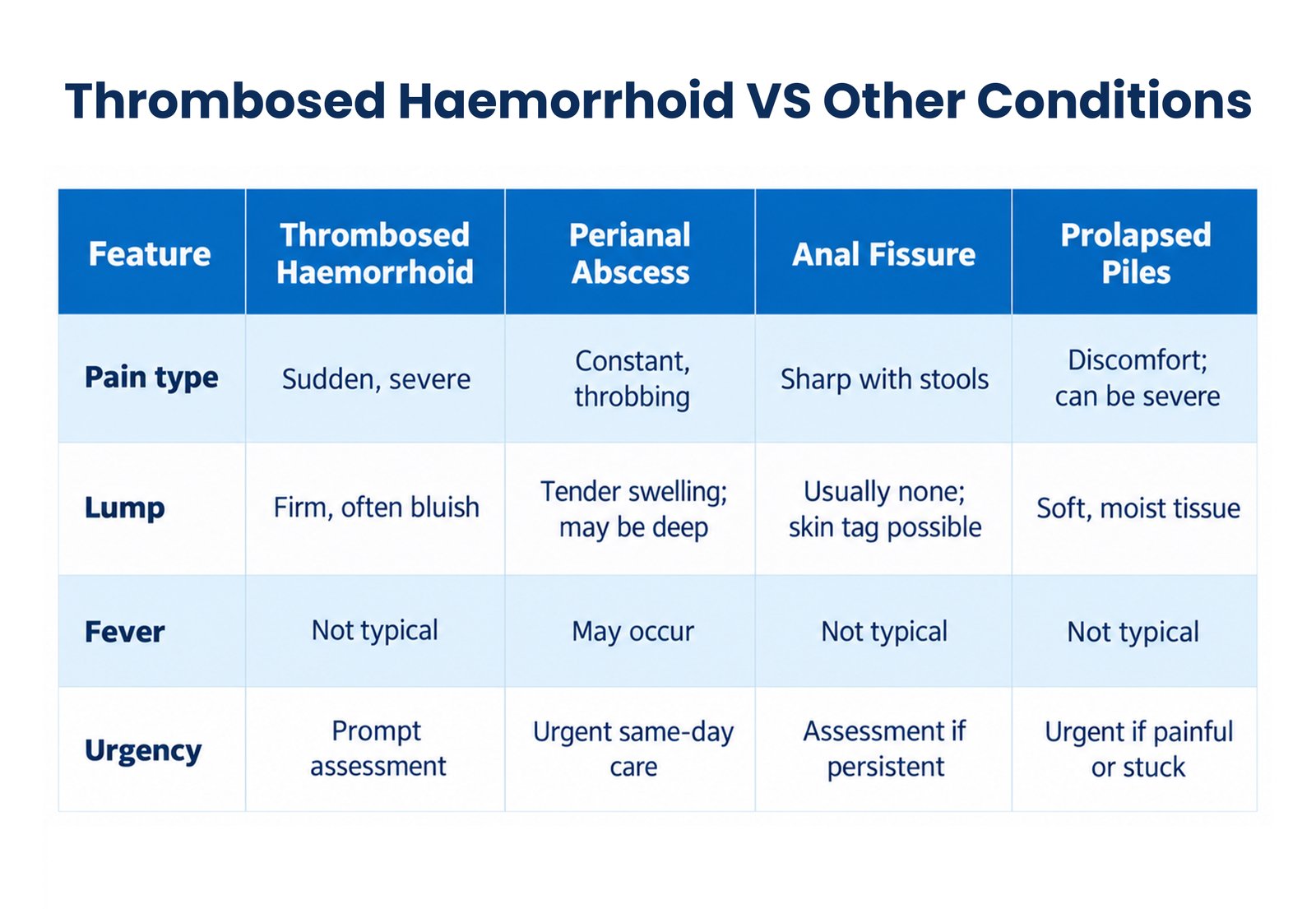
The sudden onset and specific location of a thrombosed external haemorrhoid is distinctive — but several other conditions can cause pain and swelling near the anus. Accurate diagnosis matters:
Perianal abscess: Also causes a painful swelling near the anus, but typically: develops more gradually over days, is accompanied by fever and systemic unwellness, feels soft and fluctuant rather than firm, and may have redness extending beyond the immediate swelling. An abscess requires urgent drainage — do not wait if you have fever with anal swelling.
Anal fissure: Causes severe pain but no external lump. Pain is sharp and burning, occurring during and after bowel movements, lasting 20–60 minutes. No firm swelling visible externally. May have a small sentinel skin tag but not a firm thrombosed mass.
Prolapsed internal haemorrhoid: A soft, moist lump that protrudes from inside the anal canal. Typically less acutely painful than a thrombosed external haemorrhoid. Often associated with previous prolapse episodes. May retract inside with gentle pressure — a thrombosed external haemorrhoid does not retract.
Skin tag: A painless, soft, fleshy tag at the anal margin — often the remnant of a previous thrombosis that resolved. Not acutely painful unless traumatised.
If you are uncertain which of these you have, an examination at Goyal Piles Care Centre confirms the diagnosis within minutes. Do not self-diagnose and delay if the pain is severe.
Frequently Asked Questions
Q: A very painful lump appeared near my anus overnight. What should I do? Call or WhatsApp Goyal Piles Care Centre immediately on +91-9999333166. If it has been less than 48–72 hours, a minor outpatient procedure under local anaesthetic can remove the clot and provide rapid relief. Do not wait to see if it improves. The treatment window is short.
Q: Is a thrombosed haemorrhoid dangerous? Thrombosed haemorrhoids are not dangerous. They are acutely painful and distressing but are not a life-threatening condition. The clot is confined to the haemorrhoidal vein and does not travel to other parts of the body. However, if the thrombosed haemorrhoid becomes infected and an abscess develops, this requires urgent treatment.
Q: How long does a thrombosed haemorrhoid take to heal without treatment? With conservative management — sitz baths, pain relief, stool softeners — most thrombosed haemorrhoids resolve naturally within 1–3 weeks. Pain typically peaks at 48 hours and then gradually reduces. The physical swelling takes longer to fully subside. Skin tags are commonly left behind after the clot resolves.
Q: Can a thrombosed haemorrhoid go away on its own? Yes — most do resolve naturally over 1–3 weeks with conservative care. However, for presentations within the first 48–72 hours where pain is severe, excision or drainage at Goyal Piles Care Centre provides significantly faster relief than waiting for natural resolution.
Q: Will the thrombosed haemorrhoid come back? Some patients have a single episode that never recurs. Others find it recurs periodically, particularly with episodes of constipation, heavy exertion, or prolonged sitting. If recurrence is a pattern, definitive treatment of the underlying external haemorrhoidal vessels can be discussed at Goyal Piles Care Centre after the acute episode has resolved.
If You Have Sudden Severe Anal Pain — Act Within 48 Hours
The treatment window for a thrombosed external haemorrhoid is short. If you have developed a sudden, very painful lump near your anus in the last 24–48 hours, call Goyal Piles Care Centre on +91-9999333166 right now.
Dr. Sushil Goyal, MBBS, FCGP — 37 years of treating anorectal conditions in Rohini, including thrombosed haemorrhoids, abscesses, fissures, fistulas, and piles of all grades — will assess your condition and advise on the appropriate immediate management.
476 verified Google reviews at 4.7 stars. Global Excellence Award 2019 — Best Laser Centre in North India.
📍 D-12/182, First Floor, Sector 8, Rohini, Delhi – 110085 Near Rohini East Metro Station Gate 2 | Opposite Metro Pillar No. 393 📞 Call or WhatsApp: +91-9999333166 Monday to Saturday | 9:30 AM to 1:30 PM
→ Difference between piles, fissure and fistula → Why do piles come back after treatment → Grade 3 piles treatment without surgery → Piles treatment without surgery — full guide
This article is for informational purposes only and does not constitute medical advice. Please seek immediate medical attention if you are experiencing severe pain.
